Occupational health and safety TBC
In the TBC world, no mission is urgent enough to justify intervening without protection.
Each operator must assess the scenario, use the correct equipment, and comply with the procedures established for the type of activity: work at height, suspended loads, use of vehicles, technical areas, and complex operating environments.
Safety is not a detail added to the mission.
It is the first protocol to activate and the last to deactivate.
Why a well-executed intervention is measured not only by the final result, but also by the way the team managed to complete it.
Safety first. Then the mission.
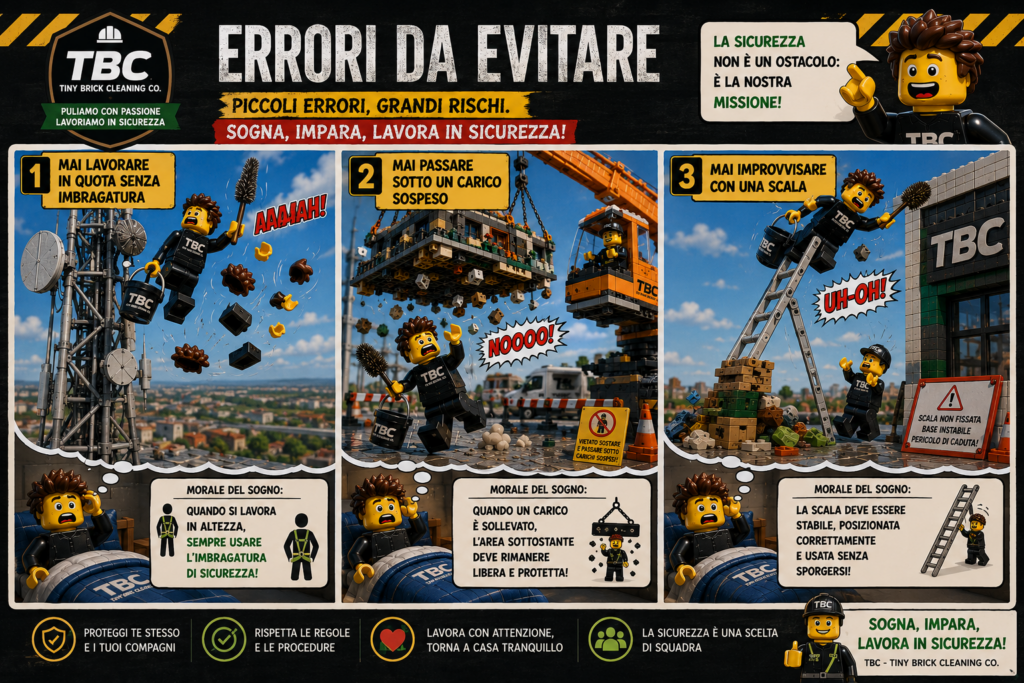
Never work at height without a harness
Every work at height requires attention, preparation, and the use of personal protective equipment.
In the dream of our TBC operator, haste takes over: he climbs the antenna to remove the dust, thinking that balance and experience are enough. A moment later he loses his footing and risks falling.
Fortunately, it is just a bad dream.
Upon waking, the lesson is crystal clear.
The TBC lesson
When working at height, the safety harness is not an option: it is the protection that can prevent very serious consequences.
Safety always starts before getting in.

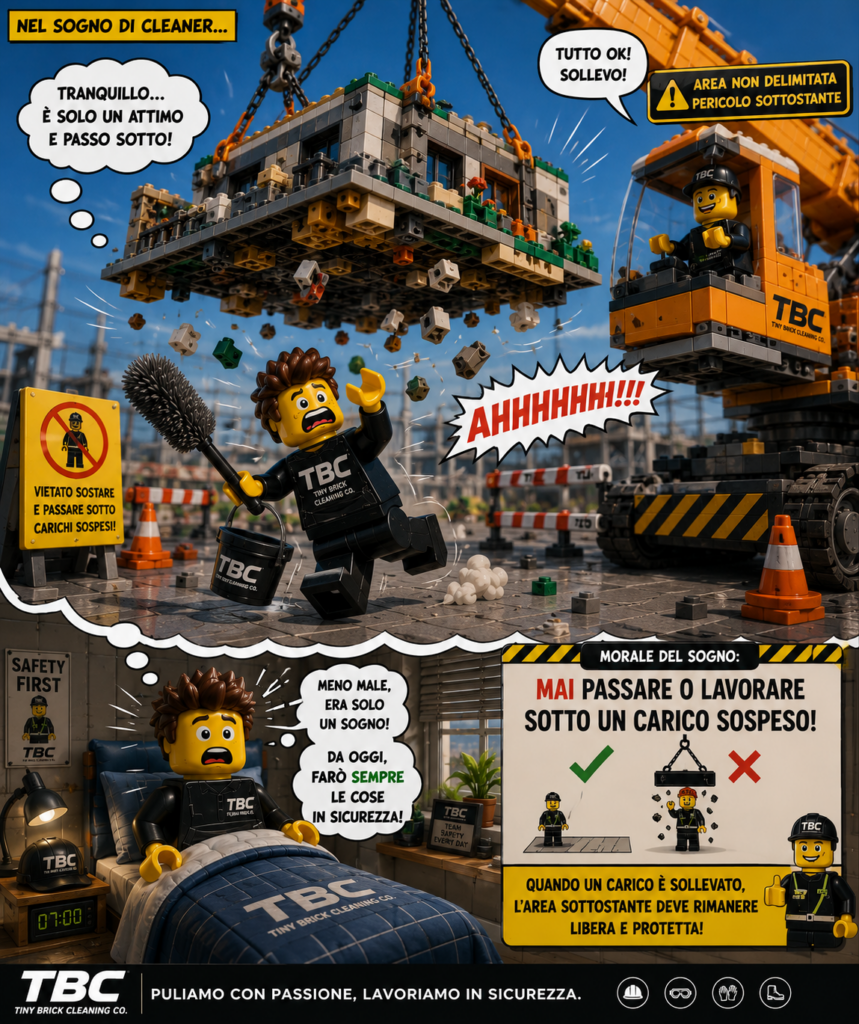
Never walk under a suspended load
During a TBC mission, a large brick structure is moved with a crane to allow the cleaning of the lower surfaces.
In our operator’s dream, the temptation is to quickly cross the work area: “It’ll only take a second.”
Right at that moment, some elements begin to move and the danger becomes immediate.
Fortunately, it's only a dream.
Upon waking up, the message is simple and impossible to forget.
The TBC lesson
When a load is lifted, the area directly below it must remain completely clear.
Never pass or work under a suspended load. Caution takes only a few seconds, an accident can change everything.
Never improvise with a ladder
Ladders are essential work tools, but also among the main causes of accidents when used incorrectly.
In the dream of our TBC operator, the mission seems simple: eliminate some dust from the top of a brick structure. To save time, however, he decides to lean the ladder on an unstable base, climbs to the very last available step, and leans sideways to reach a spot that is too far away.
For a moment, everything seems to be going well.
Then the ladder begins to wobble, tools fly in every direction, and the operator finds himself in an impossible balancing act.
Fortunately… it's just a dream.
Upon waking, the lesson is immediate.
The TBC lesson
A ladder must always be positioned on a stable surface, used correctly, and without ever leaning sideways.
If the spot you're trying to reach is too far away, the solution isn't to reach any further, but to step down and reposition the ladder.
Safety can never be taken for granted. It only takes a few seconds to set up a ladder properly, but doing so can prevent very serious consequences.

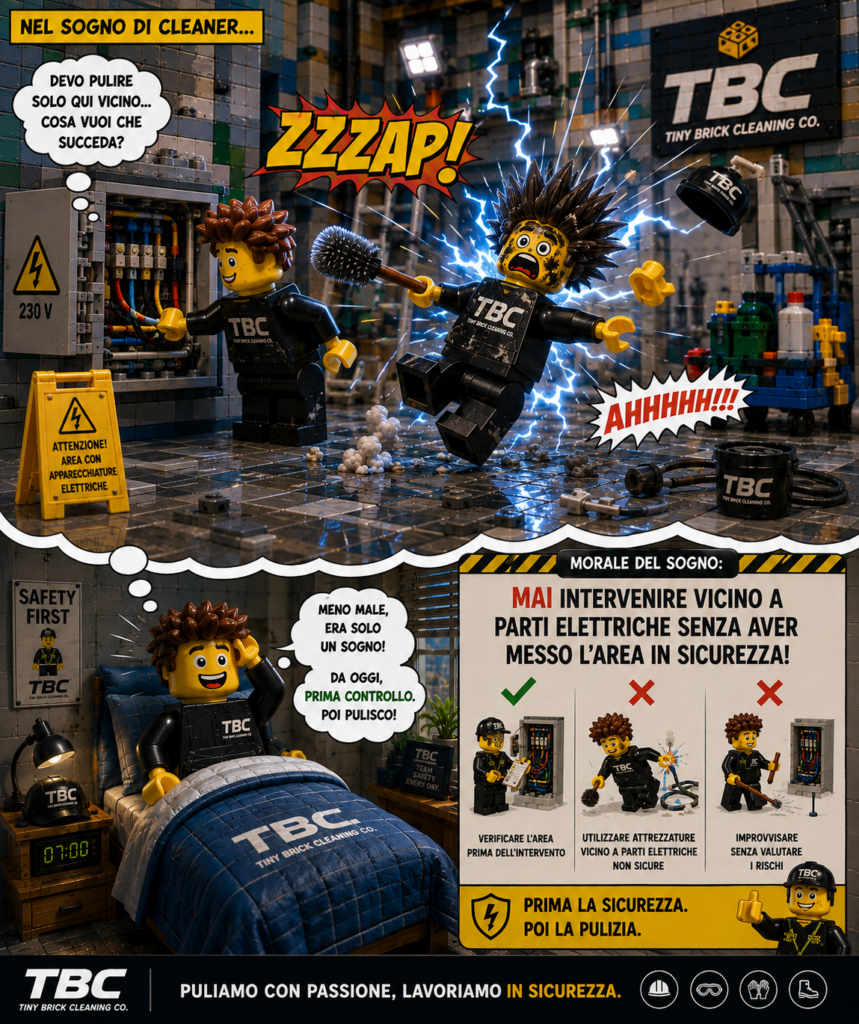
Never work near electrical components without securing the area first.
During a TBC mission, Cleaner must remove dust and fine dust from around certain electrical equipment.
In her dream, she thinks that all she has to do is pay attention: “I just have to clean around here… what’s the worst that could happen?”
One wrong move with the brush and a spectacular shock immediately reminds him that, when electricity is involved, improvising is never a good idea.
Fortunately, it's only a dream.
Cleaner wakes up with a new rule firmly fixed in his mind: first check, then clean.
The TBC lesson
Before working near electrical equipment or components, you must verify that the area has been properly secured.
Never underestimate an electrical risk, not even for a job lasting just a few seconds. Safety first. Then cleaning.
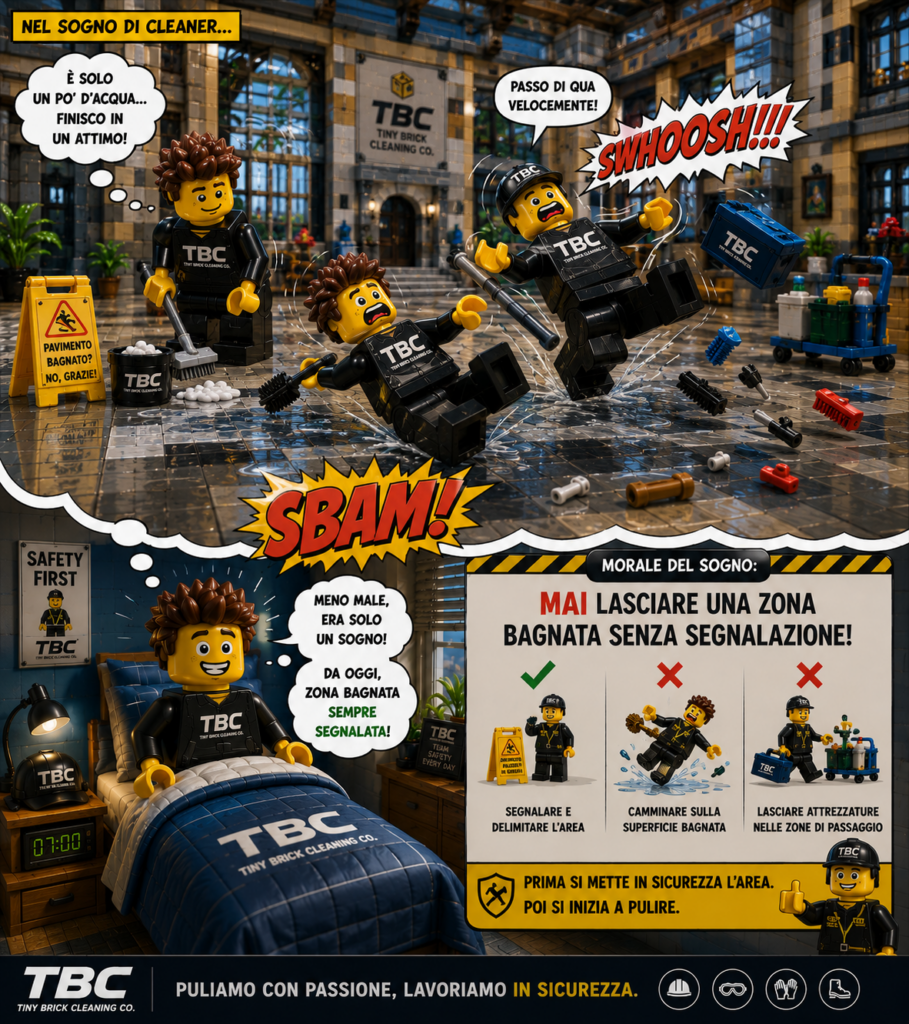
Never leave a wet area unmarked
During a TBC operation, the team is performing precision cleaning inside a large brick structure.
In our operator's dream, a small amount of water left on the floor seems like a negligible problem: “It's just a little water... I'll be done in a second.’
Just one step on the wet surface is enough for a worker to lose their balance, taking a colleague down with them and turning a few seconds of distraction into a major slip.
Fortunately, it's only a dream.
When he woke up, Cleaner knew exactly what he was supposed to do.
The TBC lesson
Any wet area must be immediately marked and, if necessary, cordoned off before continuing with the work.
Never leave a wet surface without warning. First, secure the area; then, begin cleaning.
Never underestimate fine dust
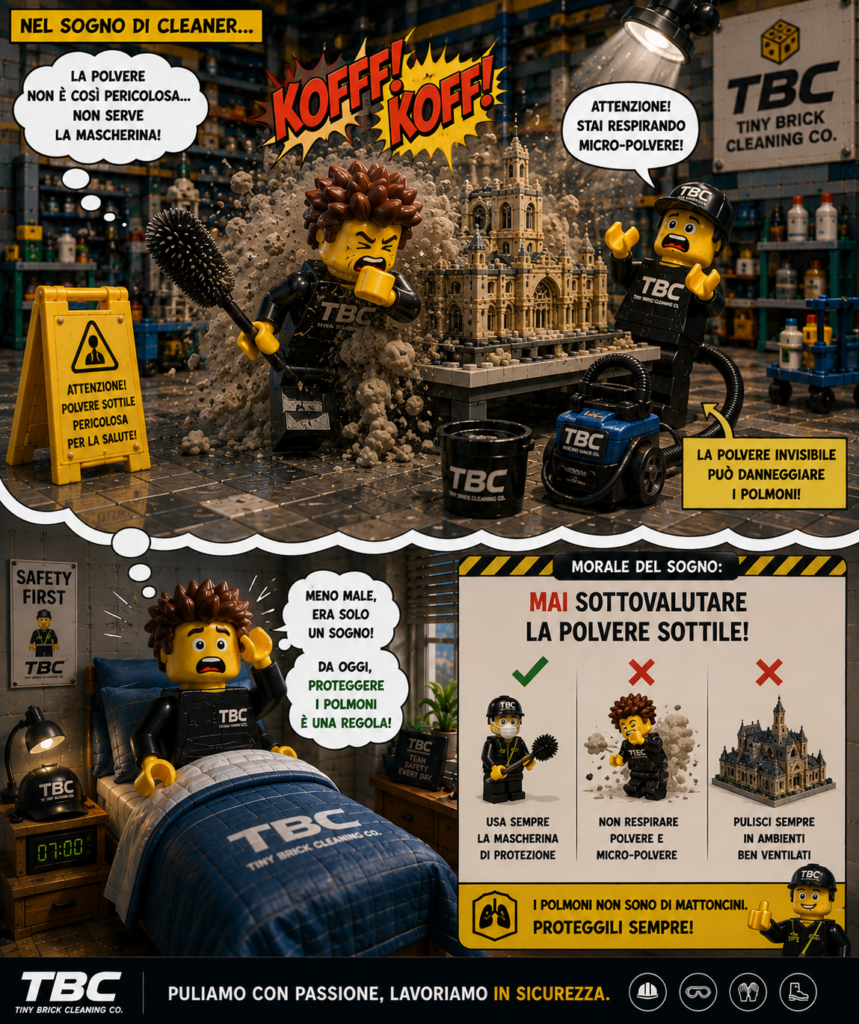
During a TBC project, Cleaner must remove a large amount of dust and fine dust that has accumulated on a complex brick structure.
In his dream, he thinks that for such a quick job, respiratory protection is unnecessary: “The dust isn't that dangerous... a mask isn't needed.”
But as soon as the cleaning starts, a large cloud of particles rises into the air and Cleaner finds himself completely enveloped in dust.
Fortunately, it's only a dream.
Upon waking up, she learned an important rule: what is barely visible can still represent a risk.
The TBC lesson
During activities that can generate dust or suspended particles, it is important to assess the risk, use appropriate protection, and work in suitable conditions.
Never underestimate dust and micro-dust. Good cleaning protects buildings, good prevention protects those who take care of them.
Never leave tools, cables, or hoses in the walkway
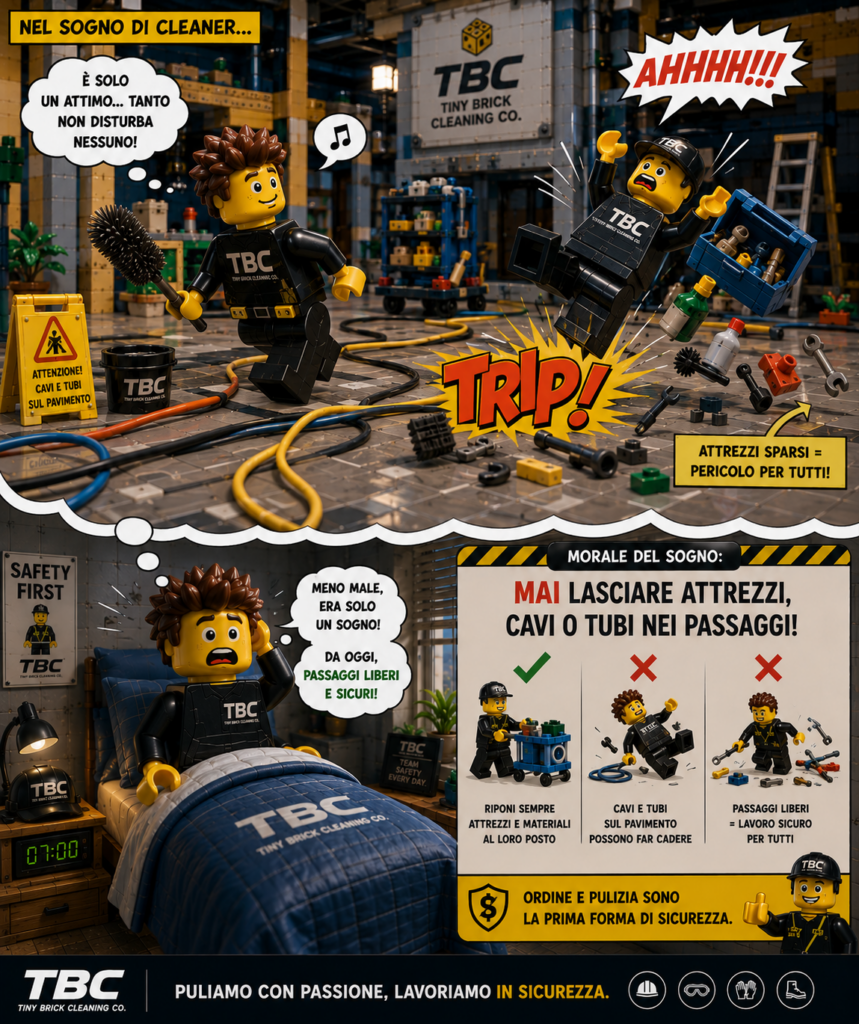
During a TBC operation, the team uses various precision cleaning tools: brushes, vacuums, hoses, and equipment of all kinds.
In our operator's dream, leaving a few tools on the floor seems harmless: “It's just for a second... besides, it's not in anyone's way.”
All it takes is a distracted coworker and a pipe in the wrong place to turn the hallway into an obstacle course and cause a spectacular tumble.
Fortunately, it's only a dream.
Upon waking, Cleaner learned that order is also a part of safety.
The TBC lesson
Tools, cables and pipes must always be properly organized, keeping walkways clear throughout the entire operation.
Never leave obstacles in transit areas. A tidy environment doesn't just make work more efficient: it makes it safer for the whole team.
Never direct blowers or jets of air toward people
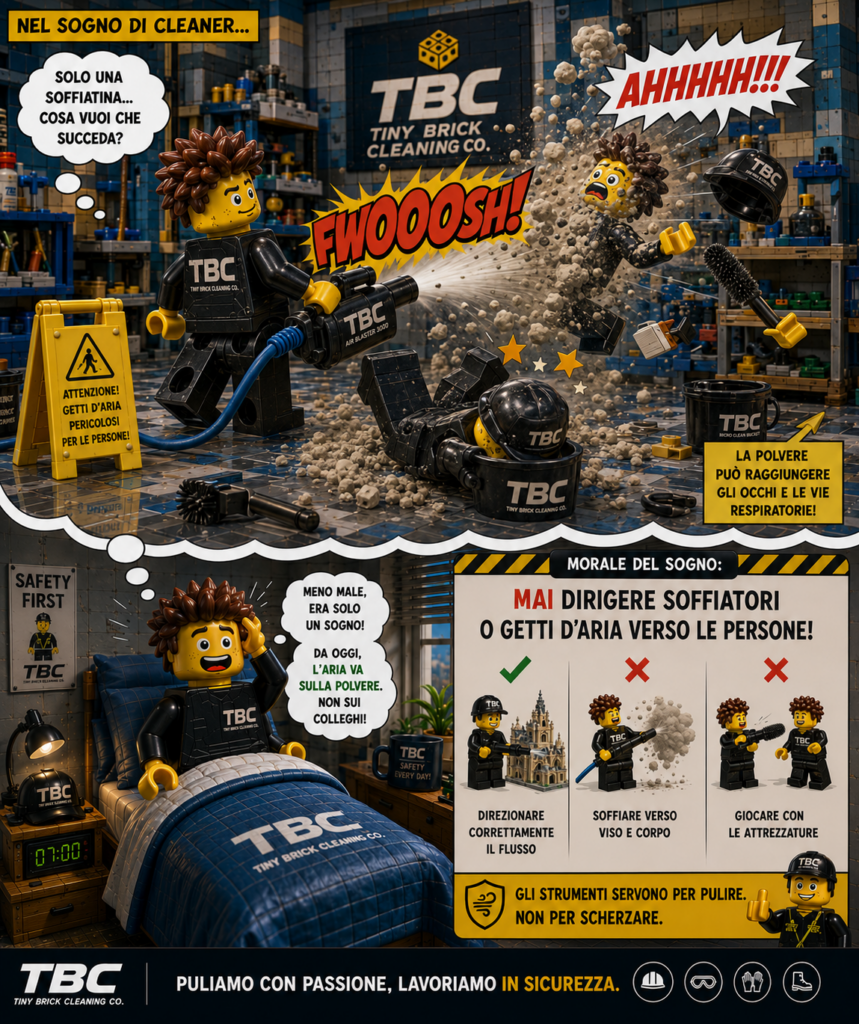
During a TBC intervention, the team uses a precision blower to remove dust and micro-dust from a complex brick construction.
In Cleaner's dream, however, a small distraction turns the work tool into a joke: “Just a little puff... what harm could it do?”
The blast suddenly kicks up a large cloud of dust, sending a helmet, brushes, and equipment flying and engulfing the colleague.
Fortunately, it's only a dream.
Upon waking, Cleaner learned that even a seemingly harmless tool must always be used correctly.
The TBC lesson
Blowers and air jets must be directed exclusively toward the surface to be treated, always avoiding the face, body, and other people present in the work area.
Tools are for cleaning, not for joking. Team safety always comes before any intervention.
Safety doesn't end here.
Continue following us, new tips, new situations, and new operating procedures are already on the way.
Why every mission changes, but safety always comes first.