Intervention Procedures
The TBC Intervention Procedures explain the operational method used by the Tiny Brick Cleaning Co. during each mission. Each phase has a precise function: observe, protect, remove, verify, and document.
No intervention is improvised. Every action follows a logical sequence, designed to respect the brick worlds, protect delicate pieces, and guarantee an orderly, safe, and documented result.
The TBC method
The TBC method is based on six main procedures. Each procedure can be applied individually or as part of a complete mission, depending on the scenario, the dust level, and the sensitivity of the set.
- Procedure 01 — Observation Observe first. Then intervene.
- Procedure 02 — Area isolation First, secure the scene. Then, take action.
- Procedure 03 — Dust removal Dust is removed. Worlds respect each other.
- Procedure 04 — Final Inspection Every detail matters. Every piece must be verified.
- Procedure 05 — Inspection of fragile parts The smallest pieces require the utmost attention.
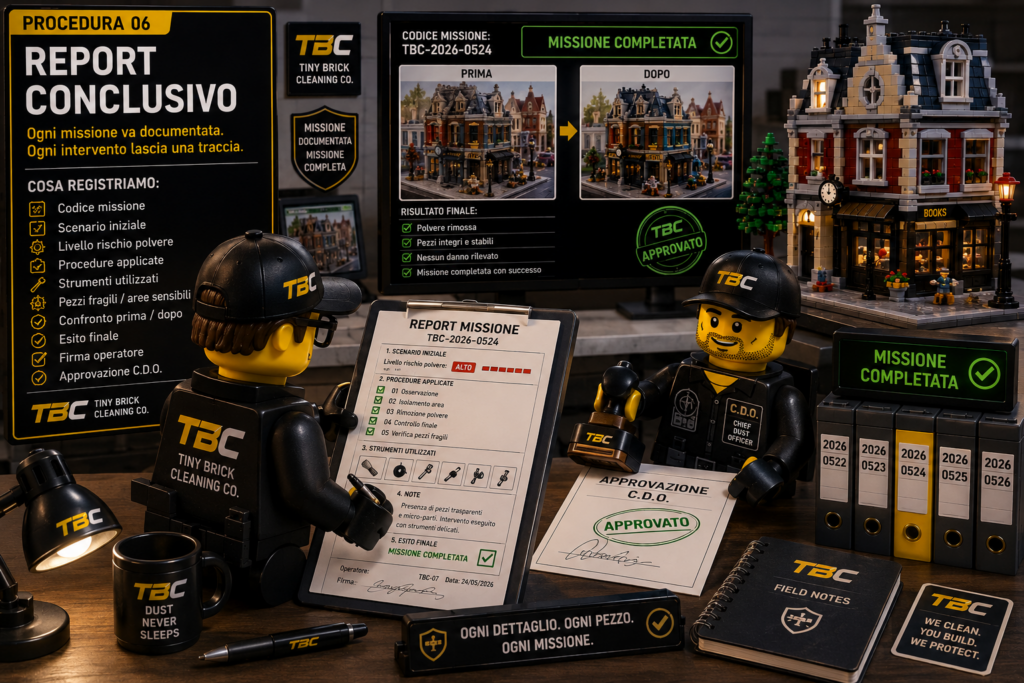
- Procedure 06 — Final Report Every mission must be documented. Every intervention leaves a trace.

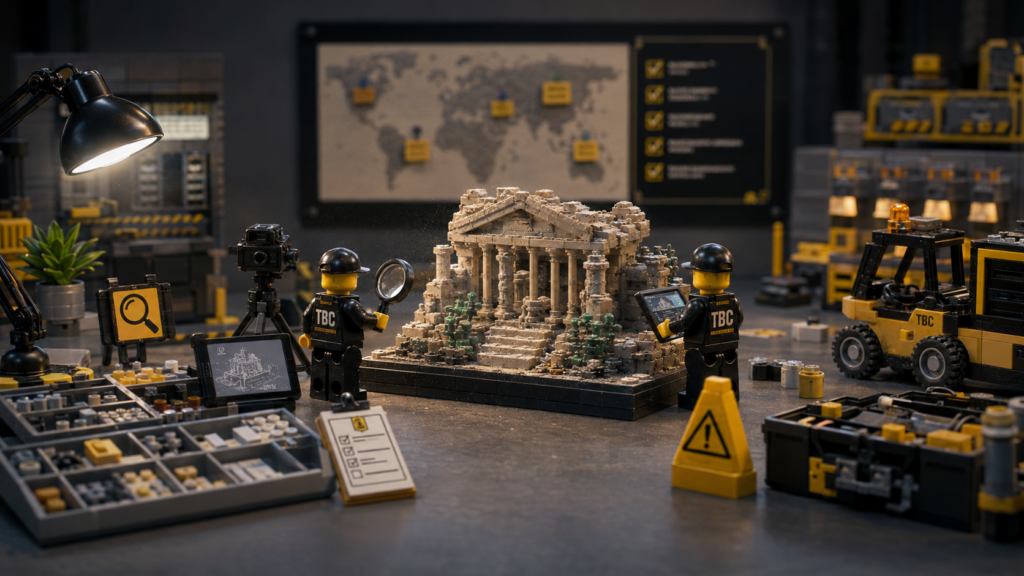
Procedure 01 — Observation
Observe first. Then intervene.
Every TBC mission begins with an observation phase. Before touching a single piece, the team analyzes the scenario, assesses the dust level, identifies sensitive areas, and spots any fragile, movable, or out-of-place items.
Observation serves to prevent damage, unauthorized movement, and overly aggressive interventions. In this phase, cleaning does not take place: one observes, studies, and documents.
- Visual analysis of the scenario
- Identification of critical areas
- Dust level assessment
- Inspection of fragile, transparent, or unstable parts
- Photographic documentation before the procedure
- Decision on the protocol to apply
A good TBC operator never goes into action without first understanding what they are protecting.
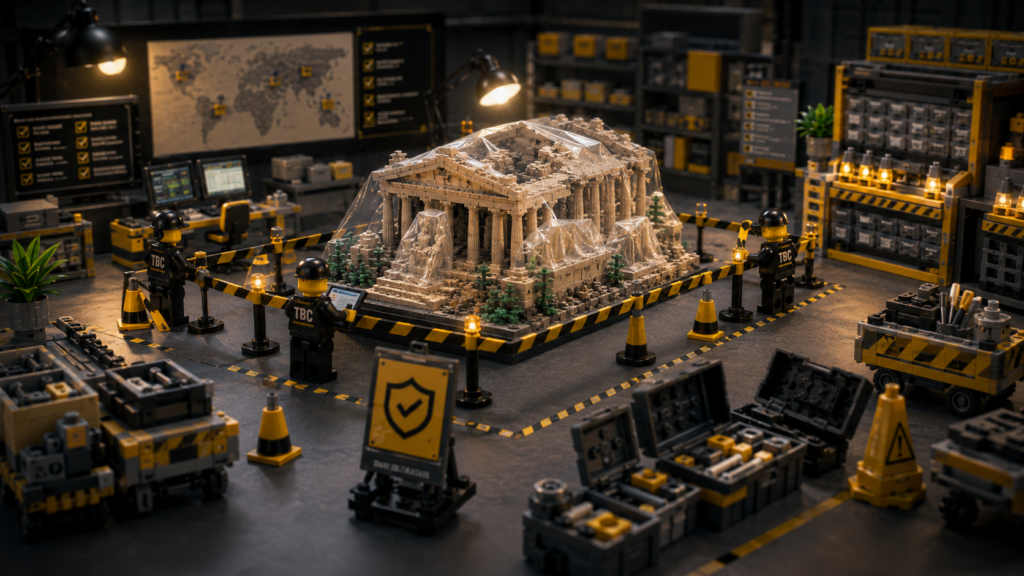
Procedure 02 — Area isolation
First, secure the scene. Then, take action.
Following the observation phase, the TBC team proceeds with the isolation of the intervention area. No operator may begin cleaning until the scenario has been demarcated, stabilized, and secured.
Isolation serves to protect the set, prevent accidental movement, avoid external contamination, and precisely define the operating perimeter. Every brick within the area is considered under temporary TBC protection.
- Delimitation of the operating perimeter
- Protection of fragile or unstable items
- Removal of unauthorized items from the area
- Positioning of safety signs, barriers and mats
- Creation of a separate tool area
- Access allowed only to assigned operators
- Final check before surgery
An isolated area is a respected area.
And a respected area is ready for the mission.
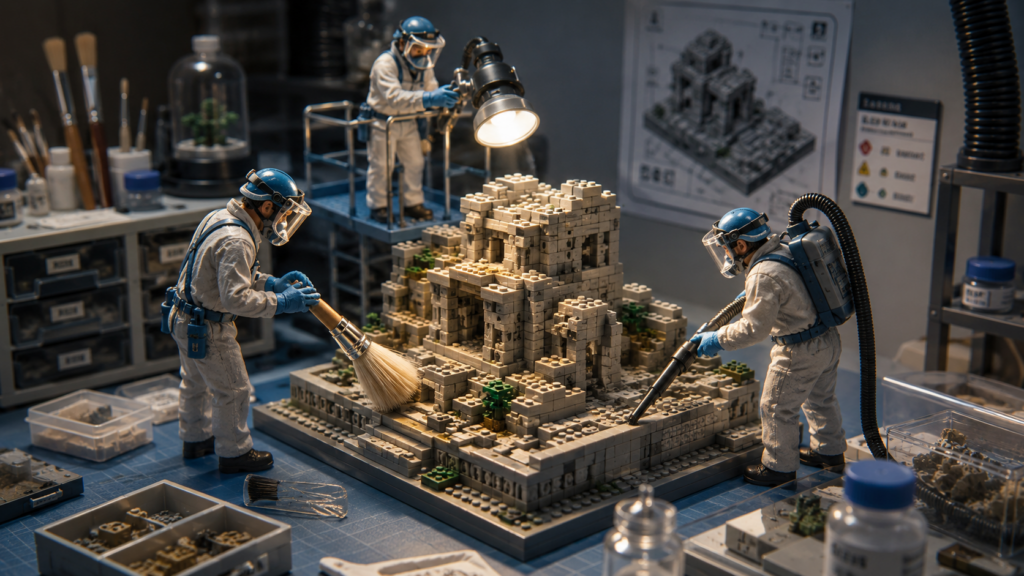
Procedure 03 — Dust removal
Dust is removed. Worlds respect each other.
After observing and isolating the area, the TBC team proceeds with the controlled removal of the dust. Each operation is carried out using tools selected based on the delicacy of the set, the amount of residue, and the stability of the pieces.
Removal must never be aggressive. The goal is not to “sweep away” the dust, but to guide it out of the scene without altering the position of the bricks, damaging delicate surfaces, or compromising the balance of the build.
- Choosing the most suitable tool
- Gradual dust removal
- Use of micro-brushes on delicate surfaces
- Controlled aspiration only where authorized
- Guard for moving, transparent or fragile parts
- Zone cleaning, without sudden movements
- Continuous monitoring during the procedure
A TBC operator never forces cleaning.
He guides it, checks it, and finishes it only when every piece is still in its place.
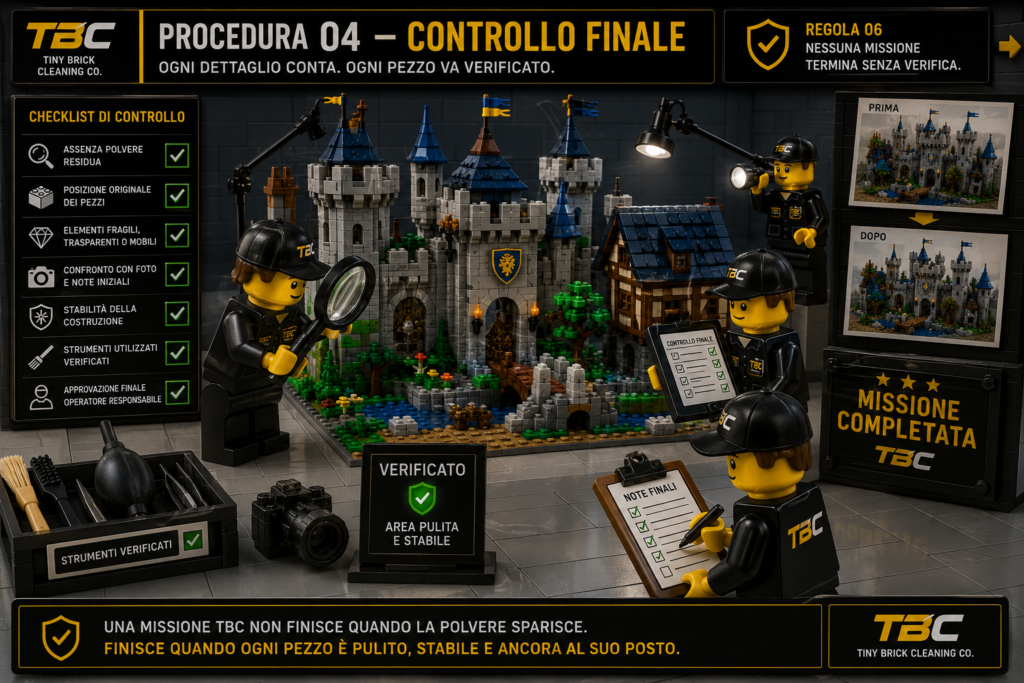
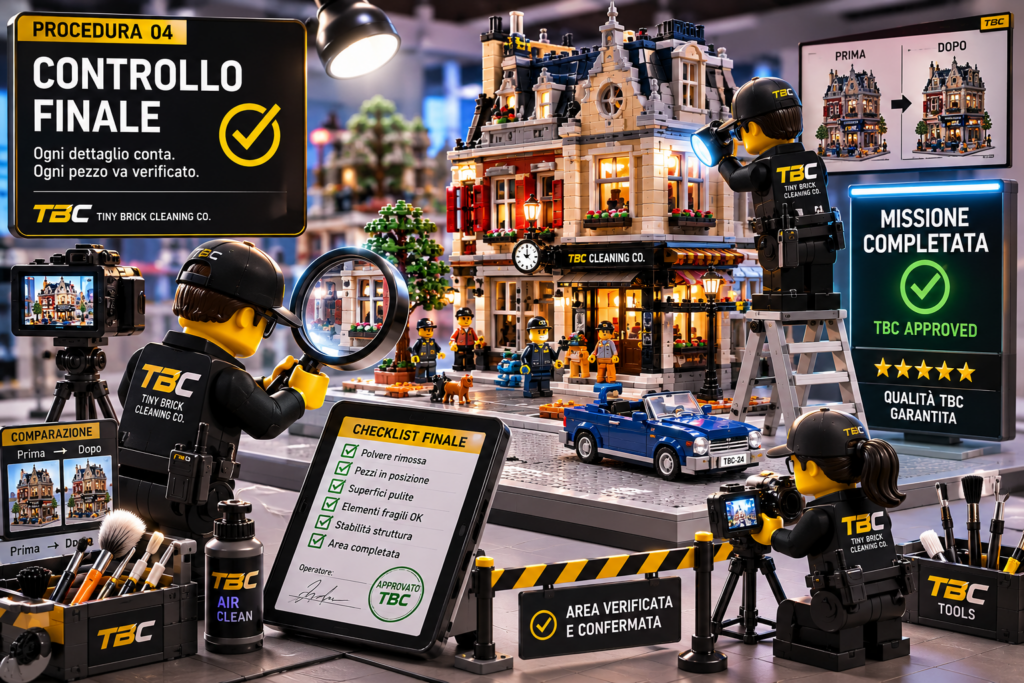
Procedure 04 — Final Inspection
Every detail matters. Every piece must be verified.
After dust removal, the TBC team proceeds with the final inspection of the treated area. This phase serves to verify that the set is clean, stable, and intact, with no displaced pieces, visible residue, or accidental damage.
The final inspection is not a simple glance: it is a technical verification. Every surface is observed, every critical area is rechecked, and every intervention is compared with the initial state documented during the observation phase.
- Verification of the absence of residual dust
- Control of the original position of the pieces
- Inspection of fragile, transparent or moving elements
- Comparison with initial photos and notes
- Building stability control
- Verification of the tools used
- Final approval by the responsible operator
A TBC mission doesn't end when the dust clears.
It ends when every piece is clean, stable, and still in its place.
Procedure 05 — Inspection of fragile parts
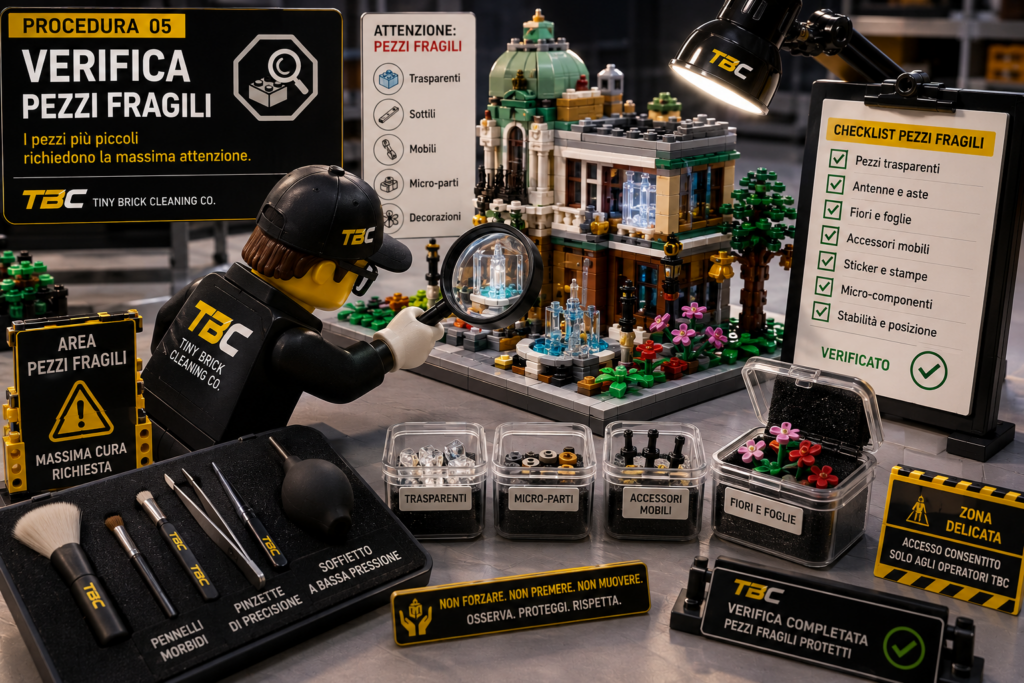
The smallest pieces require the utmost attention.
Before, during, and after each procedure, the TBC team checks for fragile, transparent, movable, or particularly sensitive items. These items are treated as special areas and require more delicate tools, controlled movements, and additional protection.
The inspection of fragile parts serves to prevent breakage, scratches, accidental detachments, loss of micro-components, or unauthorized movement. Every delicate piece is identified, protected, and checked before the mission can proceed.
- Detection of transparent, thin, or moving pieces
- Control of antennas, flowers, leaves, accessories, and micro-parts
- Inspection of stickers, prints, and delicate surfaces
- Use of gentle, non-invasive tools
- Temporary protection of sensitive areas
- Ban on direct pressure on fragile parts
- Final Stability and Position Check
A fragile piece is not an obstacle to the mission.
That is why the mission must be carried out with precision.
Procedure 06 — Final Report
Every mission must be documented. Every intervention leaves a trace.
At the end of each intervention, the TBC team draws up a final report. The report documents the initial state of the set, the issues identified, the procedures applied, the tools used, and the final result of the mission.
This phase serves to convert the procedure into working memory. Nothing is left to chance: every decision, every detail, and every final check is recorded to ensure order, traceability, and continuous improvement.
- Mission code registration
- Description of the Initial Scenario
- Dust Risk Level Indication
- List of applied procedures
- Tools and uniforms used
- Reporting of fragile pieces or sensitive areas
- Before/After comparison
- Final outcome of the procedure
- Signature of the responsible operator; Approval by the Chief Dust Officer
A mission isn't really over until the set is cleaned up.
It is complete once everything has been verified, recorded, and approved.